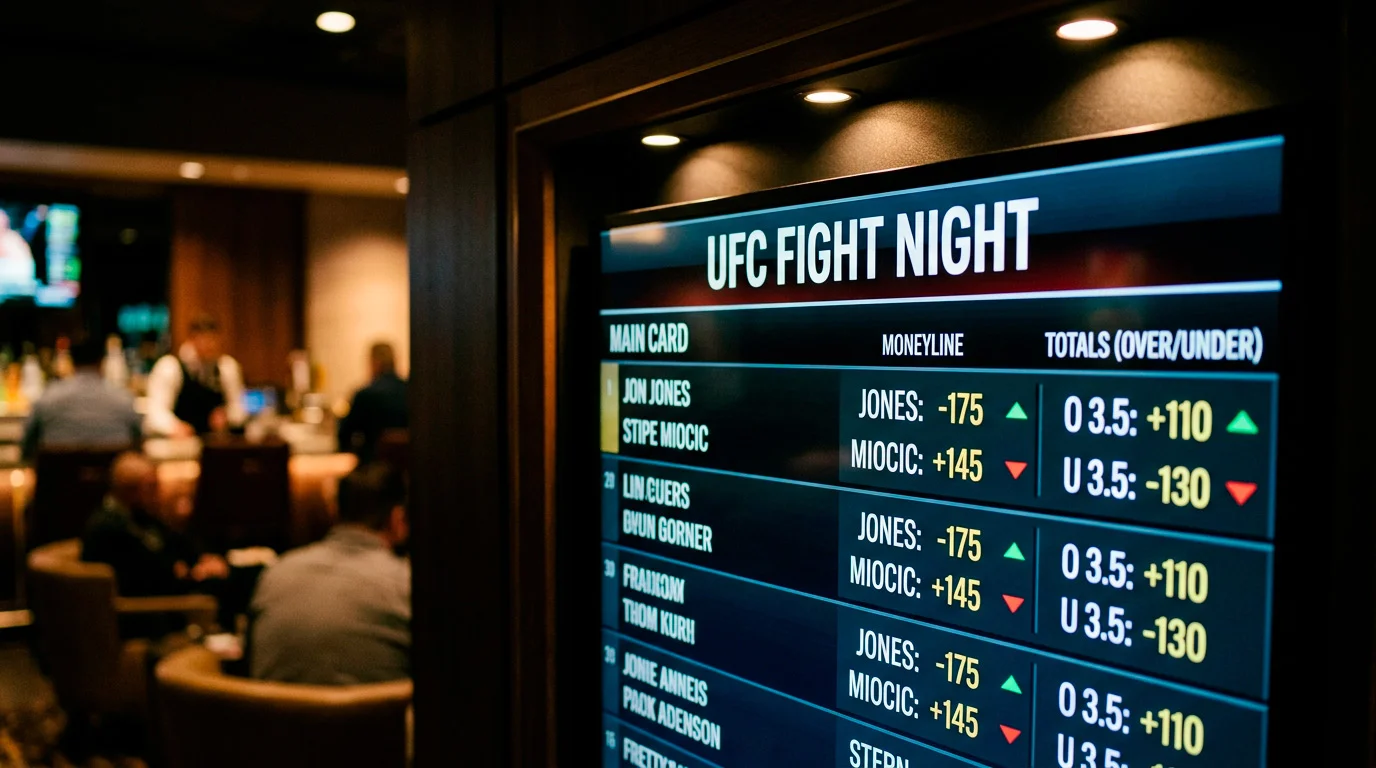
UFC Betting Odds Data and Probability Calculations
 Available in US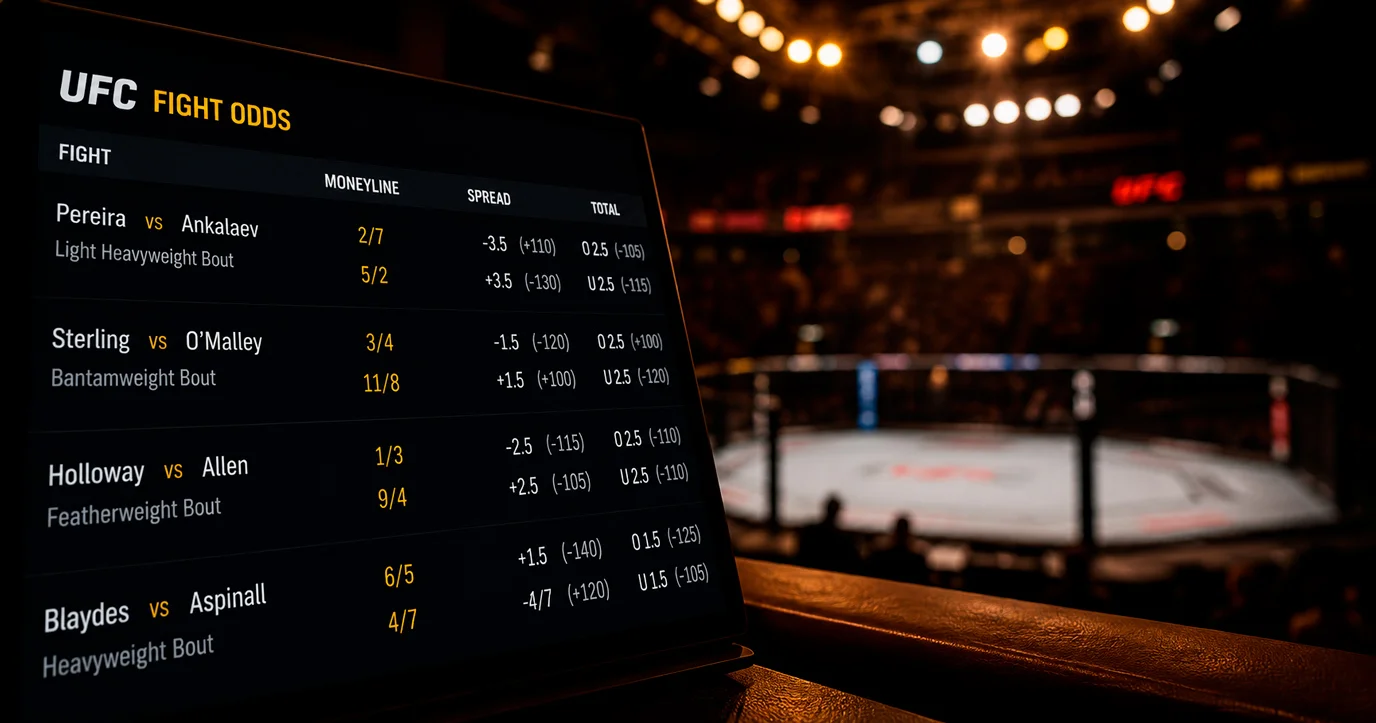
Nine years ago, I placed my first UFC bet and got the odds completely wrong. Not wrong as in I lost – wrong as in I genuinely did not understand what the numbers meant. I saw 4/1 next to a fighter’s name, assumed that was bad for him, and bet the other side. The other side was 1/7. I won about two quid on a twenty-pound stake and spent the evening wondering why anyone bothered with this sport.
That confusion is more common than anyone in the industry admits. UFC odds look simple on the surface – two fighters, two prices, pick one. But the gap between reading odds and truly understanding them is where most betting mistakes live. The MMA betting market processed $10.3 billion in handle during 2024, growing 17% year-on-year. That is a staggering amount of money flowing through a market where plenty of punters cannot explain what “implied probability” means or why the two prices on a fight never add up to 100%.
This guide breaks down every layer of UFC odds – how to read them in fractional format, how to convert them, how to extract the hidden probability buried inside each price, and how to spot the margin your bookmaker builds into every single fight. If you have ever stared at a UFC fight card and felt like the numbers were speaking a language you half-understood, this is where that ends.
Betting Odds Data – Translating Lines into Market Probability
I once had a mate tell me that odds were “just the bookmaker’s opinion.” That is half right and completely misleading. Odds are a price – literally. When a bookmaker posts 3/1 on a fighter, they are not predicting the future. They are offering you a contract: risk one unit, receive three units of profit if your fighter wins, lose your stake if he doesn’t.
Every set of odds carries two pieces of information bundled together. The first is the implied probability of an outcome. The second is the bookmaker’s margin, which is the cut they take for hosting the market. Separate those two, and you start seeing fights differently.
Think of it like buying a used car. The sticker price reflects what the dealer thinks the car is worth, plus their profit margin. The actual value of the car might be higher or lower than the sticker price. In UFC betting, the “sticker price” is the odds. Your job is to figure out whether the actual probability of a fighter winning is higher or lower than the price implies.
This distinction matters because bookmakers are not infallible. The UK sports betting market generates roughly 2.48 billion pounds in gross gaming yield each year, and a meaningful chunk of that comes from bettors who treat odds as gospel rather than as a negotiable price. UFC odds are especially vulnerable to mispricing because individual combat sports have more variables – a single punch changes everything – and because the betting public tends to overvalue name recognition and recent highlight reels.
Before we dig into the mechanics, here is the key principle: odds are an invitation to disagree. If you cannot articulate why you disagree with a price, you should not be placing the bet. Understanding what odds represent – a probability estimate wrapped in a profit margin – is the foundation of every profitable decision you will ever make in this market.
Once you understand how odds are calculated, the next logical step is to master UFC moneyline betting to pick outright winners effectively.
Fractional Odds: The UK Standard
Walk into any betting shop in the UK or open any domestic sportsbook app and the default format staring back at you is fractional. It is how British betting has displayed prices for over a century, and despite the creeping influence of decimal odds from continental Europe, fractions remain the native language of UK punters. If you are betting on UFC from Britain, this is where you start.
Fractional odds express the relationship between profit and stake. The number on the left is what you stand to win. The number on the right is what you need to risk. That is the entire system – profit over stake, separated by a slash.
Reading Fractional Odds
Take a hypothetical UFC middleweight bout. Fighter A is priced at 2/7 and Fighter B is priced at 5/2. What do those numbers actually tell you?
Fighter A at 2/7 is the favourite. For every seven pounds you stake, you get two pounds of profit back, plus your original seven – a total return of nine pounds. The short price reflects the bookmaker’s view that this fighter is likely to win. Fighter B at 5/2 is the underdog. For every two pounds you stake, you receive five pounds of profit, plus your original two – a total return of seven pounds. The longer price reflects lower perceived probability.
The key to reading fractions quickly is this: when the left number is smaller than the right, the fighter is favoured. When the left number is larger than the right, you are looking at an underdog. An “odds-on” fighter has a fraction where the potential profit is less than the stake. An “odds-against” fighter offers profit greater than the stake.
Here is a range of UFC-relevant fractional odds and what they signal:
At 1/10, you are looking at a massive favourite – risk ten pounds to win one. At 1/4, still a strong favourite – risk four to win one. At 4/6, a moderate favourite – risk six to win four. At evens (1/1), the bookmaker sees it as a coin flip. At 6/4, a slight underdog. At 3/1, a clear underdog. At 8/1, a long shot. And at 20/1, the bookmaker thinks this fighter has almost no realistic path to victory.
One thing that trips up new bettors: the fractions are not always reduced to their simplest form. You might see 10/11 instead of the cleaner-looking but equivalent price. That is normal. Bookmakers use specific fractions that correspond to standard pricing increments in the industry.
Calculating Payouts
The payout formula for fractional odds is straightforward, and once you have done it three or four times, it becomes second nature. Total return equals stake multiplied by the fraction, plus the original stake. Or, put differently: profit equals stake multiplied by the fraction, and your total return is that profit plus what you put in.
Let me walk through a concrete example. You fancy a lightweight underdog at 7/2 and want to place a ten-pound bet. Your profit calculation: 10 multiplied by 7, divided by 2, gives you 35 pounds of profit. Add back your ten-pound stake, and your total return if the fighter wins is 45 pounds.
Now try a favourite at 4/9. You stake twenty pounds. Profit: 20 multiplied by 4, divided by 9, which is 8.89 pounds. Total return: 28.89 pounds. You risked twenty to make just under nine – that is the reality of backing heavy favourites.
A third example, because I find this is where it clicks for most people. A fighter is priced at 6/5. You stake fifteen pounds. Profit: 15 multiplied by 6, divided by 5, which is 18 pounds. Total return: 33 pounds. This is a near-even fight with the underdog side giving you slightly more than your money back on a win.
The mental shortcut I use: for any fraction, divide the left number by the right number. That gives you the profit per pound staked. So 7/2 means 3.50 profit per pound. 4/9 means roughly 0.44 per pound. 6/5 means 1.20 per pound. Once you have that single number, multiply by your stake to get profit instantly.
Decimal and American Odds: A Quick Comparison
I spent two years ignoring decimal and American odds entirely, and it cost me. Not because I needed to bet in those formats, but because the sharpest line-movement analysis and most detailed UFC betting content coming out of the US and Australia uses decimal or American notation. If you cannot translate fluently, you are locked out of useful information.
Decimal odds are the simplest format in existence. The number you see is your total return per pound staked, including your stake. A fighter at 3.50 in decimal means a one-pound bet returns 3.50 (that is 2.50 profit plus your original pound). To convert fractional to decimal, divide the left number by the right and add one. So 5/2 becomes 2.5 plus 1, which is 3.50. And 2/7 becomes approximately 0.286 plus 1, which is 1.286.
American odds are the format you will encounter on US-focused sites like DraftKings. They centre everything around a one-hundred-unit reference point. A favourite is shown as a negative number – say, -350 – which means you must stake 350 to win 100. An underdog is shown as a positive number – say, +250 – which means a 100 stake wins 250. To convert fractional to American: if the fraction is greater than 1 (an underdog), multiply the decimal version minus one by 100 to get the positive American line. If less than 1 (a favourite), divide negative 100 by the decimal version minus one.
In practice, most UK sportsbooks let you toggle between formats in your account settings. I keep mine on fractional for placing bets but switch to decimal when I am doing probability calculations, because decimal odds convert to implied probability with a single division. That brings us to the most important concept in this entire guide.
Implied Probability: The Number Behind the Number
Here is a number that should change how you think about every UFC bet you ever place: favourites in the UFC won 72% of their fights in 2024. That single datapoint is interesting on its own, but it becomes powerful when you compare it to the implied probabilities baked into the odds. Bookmakers do not price every favourite at 72% – some are priced at 55%, others at 90%. The gap between the implied probability and the actual win rate is where value lives.
Implied probability is the percentage chance of an outcome that the odds suggest. Calculating it from fractional odds requires one simple formula: divide the right-hand number by the sum of both numbers, then subtract from one. For a fighter at 2/7, the implied probability is 1 minus (7 divided by 9), which equals 1 minus 0.778, giving you an implied probability of roughly 77.8%. For a fighter at 5/2, it is 1 minus (2 divided by 7), which gives approximately 71.4%. Wait – those two numbers add up to more than 100%. That is not an error. That surplus is the bookmaker’s margin, and we will get to it shortly.
If you prefer working in decimal odds, the calculation is even cleaner: divide 1 by the decimal odds. A fighter at 1.29 decimal has an implied probability of 1 divided by 1.29, or 77.5%. A fighter at 3.50 has an implied probability of 28.6%.
Why does this matter so much for UFC betting specifically? Because UFC odds in certain ranges have a track record that you can measure against implied probabilities. Heavy favourites priced between the equivalent of -400 to -900 in American odds – roughly 1/4 to 1/9 in fractional – have historically been accurate 88% to 93% of the time since 2013. That means the bookmakers do a solid job pricing dominant fighters. But fighters priced near even money – the +100 to -122 range, or roughly 4/5 to evens in fractional – have only won about 51% of the time. The implied probability at those prices suggests a win rate of 50% to 55%, and the actual results land right at the low end. That marginal accuracy in the “coin-flip” range is where patient bettors find edges.
I run implied probability calculations on every fight before I even look at the matchup details. It forces me to think in percentages rather than gut feelings. “I fancy Fighter A” is a vague instinct. “I think Fighter A wins this 65% of the time, and the market prices him at 55%” is an actionable position. The first statement is a punt. The second is value betting.
For a complete breakdown of all wagering strategies, return to our top UFC betting guide.
Overround and Bookmaker Margin
Every bookmaker in the UK takes a cut on every UFC fight they offer. It is not hidden – it is built right into the odds, and once you know how to find it, you will never look at a price the same way again.
The overround (also called the vig, the juice, or the margin) is the amount by which the combined implied probabilities of all outcomes exceed 100%. In a perfectly fair market, the implied probability of Fighter A winning plus the implied probability of Fighter B winning would equal exactly 100%. In reality, it always exceeds 100%, and the excess is the bookmaker’s theoretical profit.
Take a real-world UFC pricing scenario. Fighter A is offered at 1/3 (implied probability 75%) and Fighter B at 2/1 (implied probability 33.3%). The combined implied probability is 108.3%. That 8.3% surplus is the overround. Some operators in the UK market run UFC overrounds around 105%, which is relatively competitive. Others push closer to 110%, which means a larger share of every pound wagered goes to the house before a single punch is thrown.
The overround matters because it directly affects your long-term returns. A 5% overround means the bookmaker takes roughly 5% of every pound that cycles through a given market. A 10% overround doubles that theoretical take. Over hundreds of bets, that difference compounds brutally. The UK sports betting market pulls in about 2.48 billion pounds in gross gaming yield annually, and a chunk of that comes from bettors who never check the margin they are paying.
How do you find the best overround? Calculate the implied probability for each fighter in a bout, add them together, and subtract 100. Do this across three or four bookmakers for the same fight and you will see meaningful differences. An overround of 104% versus 109% on the same fight means one bookmaker is offering you substantially better value. This is not a marginal detail – it is the single most impactful mechanical edge available to you as a bettor, and it costs nothing to exploit.
Why Odds Shift: A Primer
UFC odds move more aggressively than odds in any team sport I follow, and understanding why they move is just as important as understanding the numbers themselves. Line movement in UFC is frequent and impactful – when a matchup gets announced, bookmakers identify their opening favourite and underdog, and as money flows in on either side, the prices shift toward whoever is attracting the most action.
There are three primary drivers of UFC line movement. The first is sharp money – bets from known profitable accounts or syndicates that bookmakers respect and react to quickly. When a sharp bettor puts serious money on an underdog, the bookmaker does not wait to see if the public agrees. They move the line immediately, sometimes within minutes.
The second driver is public money – the cumulative weight of recreational bettors piling onto one side. This tends to happen with popular fighters and main event headliners. Public money moves lines slowly but predictably, usually inflating the favourite’s price and creating potential value on the other side.
The third driver is information. An injury report leaking on social media, a video of a bad weight cut circulating among MMA journalists, or a camp change announced two weeks before a fight – all of these trigger immediate repricing. UFC is uniquely vulnerable to information-driven line movement because a single fighter’s physical condition matters far more than it does in a team sport where fourteen other players can compensate.
I track line movement for every fight on my card starting from the moment odds are posted, which is usually seven to ten days before the event. The opening line is my reference point. If a fighter opens at 6/4 and drifts to 2/1 by fight night, that tells me the market is moving away from him – either sharps disagree with the opening assessment or negative information has surfaced. If the same fighter opens at 6/4 and gets bet down to evens, money is coming in on his side. Neither direction guarantees a winner, but both tell you something the raw number cannot.
A rising share of UFC betting volume now comes from sophisticated bettors who treat line movement as a data source in its own right. You do not need to be one of them to benefit – you just need to notice when the price you saw on Monday looks different on Saturday and ask yourself why.
Frequently Asked Questions
How do I calculate my potential winnings from fractional UFC odds?
Multiply your stake by the left number, then divide by the right number. That gives you your profit. Add your original stake back for your total return. For example, a 10-pound bet at 7/2 returns 35 pounds profit plus your 10-pound stake, totalling 45 pounds.
Why do UFC odds change between the announcement and fight night?
Three factors drive movement: sharp bettors placing large wagers that bookmakers respect, the cumulative effect of public money favouring one side, and new information like injury reports, weight-cut issues, or camp changes. UFC lines are particularly volatile because individual fighter condition affects outcomes far more than in team sports.
What is the overround, and how does it affect my UFC bets?
The overround is the bookmaker’s built-in margin. It is the amount by which the combined implied probabilities of all outcomes in a fight exceed 100%. A 105% overround means the bookmaker theoretically keeps about 5% of all money wagered on that fight. Lower overrounds mean better value for you, so comparing the same fight across multiple bookmakers is worth the effort.
Are decimal or fractional odds better for UFC betting in the UK?
Neither is inherently better – they express the same information in different formats. Fractional is the UK default and most familiar to domestic punters. Decimal is easier for quick implied probability calculations (just divide 1 by the decimal odds). Many experienced bettors use fractional for placing bets and switch to decimal for analysis.
Created by the ”how to bet on a ufc Fight” editorial team.