UFC Betting Guide
UK UFC Betting Analysis and MMA Wagering Strategies
By MMA Betting Analyst
 Available in US
Nine years ago, I placed my first bet on a UFC fight. It was a main event, I picked the favourite because his highlight reel looked terrifying, and I lost. The experience taught me nothing about MMA betting — but everything about how not to approach it. Since then, I’ve built a career around analysing fights, tracking odds, and figuring out where the numbers disagree with reality. This guide is the distillation of all that work, written specifically for UK punters who want to bet on UFC fights with their eyes open.
The MMA betting handle hit $10.3 billion in 2024, a 17% jump from the year before — and that figure is still climbing. The UFC now runs 43 live events every year, split across 13 marquee numbered cards and 30 Fight Night shows, pumping out 350 hours of live programming that UK bookmakers cover with increasingly deep markets. This isn’t a fringe sport anymore. It’s a global betting product, and the UK is one of the most active regulated markets in the world for wagering on it.
But here’s the problem. Most guides you’ll find online are thinly disguised bookmaker adverts. They’ll tell you to “research the fighters” without explaining which numbers actually matter. They’ll mention value betting without showing a single calculation. They’ll list bet types with one-sentence definitions and call it education. I’ve read every major UFC betting guide in the UK search results, and not one of them includes the data you need to make informed decisions — underdog win rates, odds accuracy ranges, market handle figures, or the regulatory changes hitting UK operators right now.
This guide fills those gaps. Every section is anchored by real statistics, not marketing copy. I’ll walk you through odds mechanics in fractional format, break down every bet type available on UK sportsbooks, show you how to analyse fighters using free data, introduce live betting with specific in-play signals, and explain the UK regulatory landscape — including the duty overhaul that’s reshaping the industry as you read this. Whether you’ve never placed a bet or you’ve been punting on UFC cards for years, there’s something in here that will sharpen your approach.
- UFC Wagering Insights – Data from MMA Betting Markets
- Why UFC Betting Has Exploded — and Why That Matters for Your Wagers
- UFC Odds in the UK: Reading Fractional Lines and Finding What They Hide
- 2/5 means risk £5 to win £2 — see exactly what your fractional bet returns
- Every Bet Type on a UFC Card — and When Each One Earns Its Keep
- Analysing Fighters Like a Bettor, Not a Fan
- Reading a Fight Card Before You Open Your Betting App
- Live Betting on UFC: What Happens When the Cage Door Closes
- Bankroll Rules That Keep You in the Game When Your Picks Don’t
- The UK Regulatory Landscape: What Changed in April 2026 and Why You Should Care
- From Account to Wager: Placing Your First UFC Bet Step by Step
- Three Mistakes That Cost New UFC Bettors the Most Money
- Common Questions About UFC Betting in the UK
UFC Wagering Insights – Data from MMA Betting Markets
- The MMA betting market hit $10.3 billion in 2024 and is still growing — UFC’s 43 annual events give UK punters nearly weekly opportunities to find value.
- Favourites win 72% of UFC fights, but odds near even money (+100 to -122) are accurate only 51% of the time — the closer the line, the less the market actually knows.
- Fractional odds, implied probability, and overround are the three concepts you must understand before placing a single bet; skip them, and you’re flying blind.
- The UK’s Remote Gaming Duty jumped from 21% to 40% in April 2026, pushing operators to widen margins — line shopping across licensed bookmakers has never mattered more.
- Bankroll discipline beats pick quality: flat staking at 1-3% per wager, tracking every bet, and treating parlays as entertainment rather than strategy.
Why UFC Betting Has Exploded — and Why That Matters for Your Wagers
A mate of mine who works at a UK-licensed sportsbook told me something last year that stuck with me: “UFC is the fastest-growing sport on our platform, and we still don’t have enough traders who actually understand it.” That one sentence explains a lot about why this market is worth your attention. Growth creates opportunity — for punters who do their homework.
$1.5 billion
UFC revenue in 2025, with an EBITDA margin of 57%
$10.3 billion
Global MMA betting handle in 2024, up 17% year-on-year
43 events per year
13 numbered cards plus 30 Fight Nights, totalling 350 hours of live action
$7.7 billion
The UFC’s new seven-year media deal with Paramount, averaging $1.1 billion annually
Those four numbers tell the story of a sport that’s crossed from niche entertainment into mainstream commercial force. UFC revenue reached $1.502 billion for the full 2025 year, producing an EBITDA margin of 57% — one of the highest among major sports properties globally. Sponsorship revenue alone jumped by $62.9 million to $314.3 million that same year. The organisation isn’t just growing; it’s becoming more valuable to everyone around it, including bookmakers.
The Paramount media deal, signed in 2025 and kicking in from 2026, deserves special attention. At $7.7 billion over seven years, it more than doubles the value of the previous ESPN contract, which averaged roughly $500 million annually. More importantly for bettors, this deal eliminates the pay-per-view model entirely. Every UFC event will now be accessible through a standard streaming subscription. That means more eyeballs, more betting volume, and — critically — more market liquidity on fight nights. When more money flows into a market, the odds become sharper. When odds are sharper, finding value requires sharper analysis. This is a rising tide, but it doesn’t lift all boats equally.
The global sports betting market itself is valued at $125.12 billion in 2026 and is projected to reach $325.71 billion by 2035. MMA is one of the fastest-growing segments within that market. Dana White, the UFC’s president, has been characteristically blunt about the relationship between his sport and legal betting: the UFC actively supports a healthy, legal sports betting market because it drives fan engagement, broadcast value, and sponsorships. When legal betting is discouraged, in his view, it damages the ecosystem the organisation has spent years building with state regulators and licensed operators.
UFC’s sponsorship portfolio featured 104 unique brands active across 481 tracked assets in 2025 — fewer brands than the 2021 peak of 215, but each with deeper, more integrated activations.

What does this mean in practical terms? The UFC is a sport deliberately designed around betting. Events are scheduled with wagering audiences in mind. Markets are deep. Data is available. And because it’s a one-on-one sport — no team dynamics, no substitution benches, no weather delays — the analytical framework is simpler than most sports, even if mastering it isn’t.
Understanding why the market is growing matters because it shapes the conditions you bet in — but the first skill you need is reading the odds sitting in front of you.
UFC Odds in the UK: Reading Fractional Lines and Finding What They Hide
I still remember the first time I looked at a UFC betting slip and genuinely didn’t understand what 4/1 meant in terms of actual money coming back. It’s the kind of thing that feels embarrassing to admit, but I’ve since learned that most beginners quietly struggle with the same thing — they just don’t say it out loud. Odds aren’t complicated once you see the logic, but UK fractional format has a quirk that trips people up: the number tells you your profit, not your total return.
The UK sports betting market generates approximately £2.48 billion in annual gross gaming yield, and the vast majority of that action runs through fractional odds by default. Every UK-licensed bookmaker will show UFC lines this way unless you manually switch to decimal or American format in your settings. So let’s make sure you can read them cold. For a deeper breakdown covering decimal and American formats, overround margins, and odds movement patterns, I’ve written a full guide to UFC betting odds that goes well beyond what I can cover here.
Fractional Odds Walkthrough
Fighter A — 2/5 (favourite)
Fighter B — 7/4 (underdog)
A £50 bet on Fighter A at 2/5: profit = £50 x (2/5) = £20. Total return = £70.
A £50 bet on Fighter B at 7/4: profit = £50 x (7/4) = £87.50. Total return = £137.50.
Tool by CageStats
2/5 means risk £5 to win £2 — see exactly what your fractional bet returns
Convert any fractional odds to profit and implied probability, and simulate a 2% unit staking plan across a full card season.
The number on the left is what you win, the number on the right is what you stake.
Exact example from this guide: Fighter A at 2/5 with a £50 stake returns £20 profit (£70 total), implied probability 71.4%. Fighter B at 7/4 with the same stake returns £87.50 profit (£137.50 total), implied probability 36.4%. Combined, the two sides sum to 107.8% — the 7.8% above 100% is the bookmaker’s overround.
Flat staking at a fixed percentage of bankroll — the discipline that survives losing streaks.
Exact worked example from this guide: £500 bankroll, 2% unit (£10), average odds 5/4, 20 bets at a 55% win rate — 11 wins produce £137.50, 9 losses cost £90.00, net result +£47.50. That’s the realistic ceiling for consistent UFC betting; anyone promising 70% win rates is selling something other than expertise.
Content is informational, not financial advice. BeGambleAware
The fraction works like this: the number on the right (denominator) is what you stake, the number on the left (numerator) is what you win. At 2/5, you need to put up £5 to win £2 in profit. At 7/4, every £4 staked earns you £7. The favourite always has a smaller numerator relative to the denominator — you’re risking more to win less, because the bookmaker considers that outcome more likely.
Where it gets interesting — and where most casual bettors stop paying attention — is the gap between what the odds imply and what actually happens inside the octagon.
Implied Probability Calculation
Implied probability — the percentage chance of an outcome that the bookmaker’s odds reflect. It’s the mathematical translation of a price into a likelihood, and it always includes the bookmaker’s margin.
Converting fractional odds to implied probability
Formula: Implied probability = denominator / (numerator + denominator) x 100
Fighter A at 2/5: 5 / (2 + 5) x 100 = 71.4%
Fighter B at 7/4: 4 / (7 + 4) x 100 = 36.4%
Combined: 71.4% + 36.4% = 107.8%
The 7.8% above 100% is the bookmaker’s overround — their built-in margin on every market.
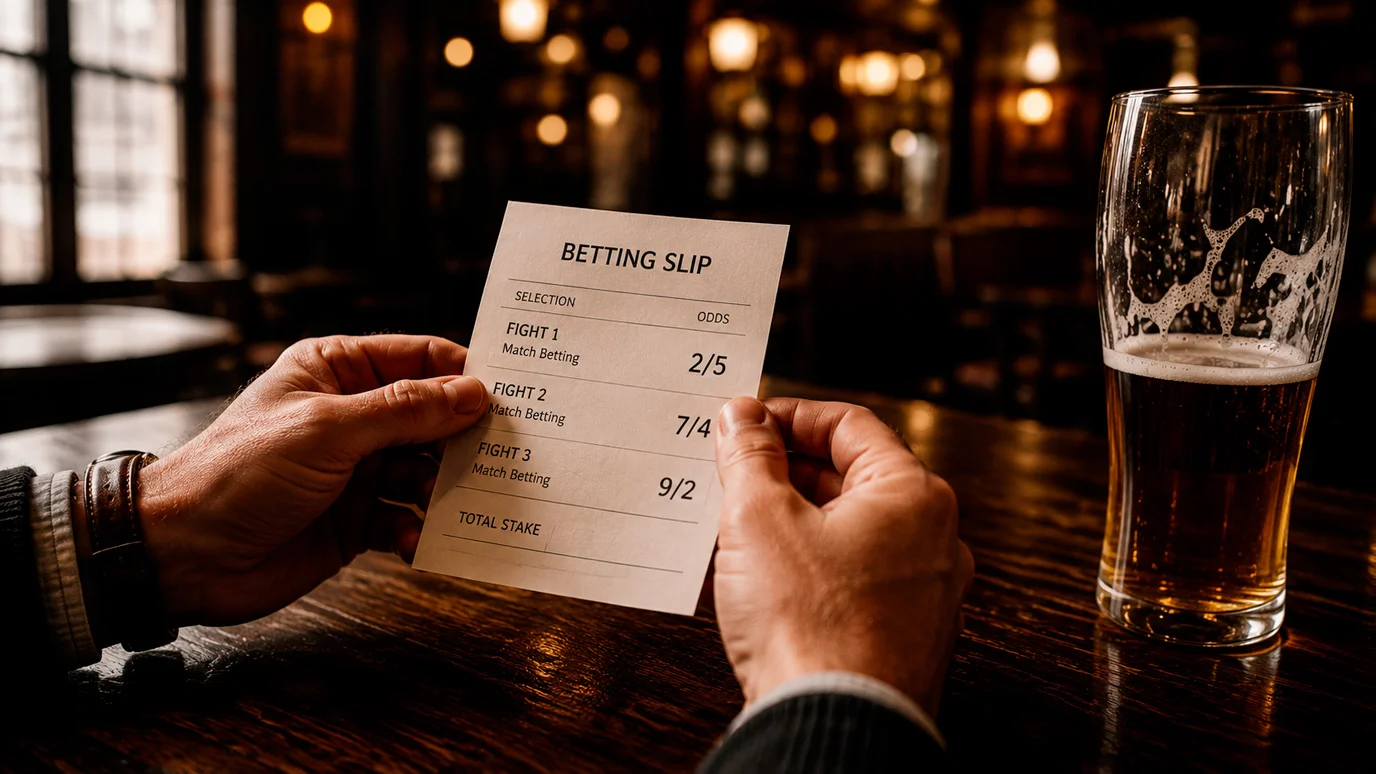
That overround matters. It means the odds you’re offered always slightly understate your true potential payout. In a perfectly fair market, implied probabilities would sum to exactly 100%. In reality, UK bookmakers typically run an overround of around 105% on UFC main events — competitive by industry standards, but it’s still a tax on every bet you place. Understanding that this margin exists is the first step toward finding value, because value betting is fundamentally about identifying spots where your own probability estimate exceeds the implied probability embedded in the price.
Here’s a number that should shape how you think about UFC odds: favourites won 72% of their bouts in 2024. That sounds decisive until you look closer. UFC odds in the range of -400 to -900 (heavy favourites) proved accurate between 88% and 93% of the time over a decade of data. But odds in the near-even range — roughly +100 to -122 — only delivered the expected outcome 51% of the time. That’s essentially a coin flip dressed up as a priced market. The lesson: not all odds ranges carry the same informational weight, and the closer a fight is to even money, the less confidence you should place in what the line is telling you.
Every Bet Type on a UFC Card — and When Each One Earns Its Keep
My first year of UFC betting, I placed nothing but moneyline bets. Every single one. It took me embarrassingly long to realise I was leaving entire categories of value on the table — markets where my actual analysis of how a fight would play out could translate into a more precise wager than simply picking a winner. The UFC offers more bet types than most people realise, and understanding each one is the difference between betting and analysing. For the complete deep dive into every market with worked examples, head to the full UFC bet types breakdown.
Moneyline
Pick the winner. The simplest bet and the foundation of every UFC betting slip.
Method of Victory
Bet on how the fight ends: KO/TKO, submission, or decision.
Round Betting
Predict the exact round of a finish or bet the over/under on total rounds.
Props
Specials like “fight to go the distance,” time props, or fighter performance markets.
Parlays
Combine multiple selections into one wager for amplified odds — and amplified risk.
Futures
Bet on long-term outcomes: who will hold a divisional belt at a future date.
Moneyline
The moneyline is where everyone starts, and there’s nothing wrong with staying here if your edge is in picking winners. You choose which fighter wins the bout — that’s it. No method, no round, no conditions. The favourite wins more often than not, which sounds like a comfortable proposition until you factor in the prices. Backing every favourite blindly at the offered odds would have produced a loss over a full calendar year, because the margin built into short-priced lines erodes your profit faster than the win rate replenishes it.
Moneyline example
Fighter A: 1/3 (favourite) — implied probability 75%
Fighter B: 9/4 (underdog) — implied probability 30.8%
A £30 bet on Fighter A returns £40 total (£10 profit). A £30 bet on Fighter B returns £97.50 total (£67.50 profit).
Method of Victory
This is where fight knowledge starts to pay off. Instead of just picking a winner, you’re predicting how they win — KO/TKO, submission, or decision. The prices are longer because you’re adding a layer of specificity, but that’s exactly the point. If you’ve studied a fighter’s style and you know they finish opponents on the feet, betting on them to win by KO/TKO at 7/2 offers significantly more value than backing them on the moneyline at 4/7. The risk is proportional to the reward, and method markets are where stylistic analysis converts into real edge.
Round Betting and Totals
Round betting comes in two flavours. Exact round betting asks you to pick the specific round a fight ends in — high-risk, high-reward, and generally reserved for fights where you have a strong read on both fighters’ durability and output. Over/under rounds is more forgiving and, in my experience, more consistently profitable. A typical three-round fight will have a line set at 1.5 or 2.5 rounds; a five-round championship bout usually sits at 2.5 or 3.5. The question is whether the fight finishes early or goes deep.
The key distinction that matters here: UFC main events and title fights are five rounds, while everything else on the card is three. That structural difference changes the maths entirely. A fighter who fades in the fourth round is irrelevant in a three-round prelim but critical in a main event. Always check the number of scheduled rounds before you touch a totals market.
Props, Parlays, and Futures
Props — short for proposition bets — cover everything outside the core markets. “Fight to go the distance” is the most popular, and it’s essentially a yes/no wager on whether the bout reaches the judges’ scorecards. Time props let you bet on the fight ending within a specific time window. Fighter performance props might cover things like total knockdowns or significant strikes landed.
Parlays (called accumulators in UK terminology) combine multiple selections into a single slip. The odds multiply, which makes the potential payout look enormous — and that’s precisely the trap. Each additional leg reduces your probability of winning exponentially. I’ve seen too many punters string together five “sure thing” favourites at short prices and lose on the fourth leg. Parlays have their place, but they should be a small, deliberate part of your approach, never the backbone.
Futures markets let you bet on long-term outcomes — typically which fighter will hold a specific divisional title by a given date. These tie up your stake for months, sometimes longer, and require a different kind of analysis: not just who wins the next fight, but who navigates the matchmaking, stays healthy, and makes it to the title shot. The UFC’s near-weekly event schedule and constant roster movement create genuine futures value for punters willing to be patient.
Knowing which bets exist is step one — knowing which fights deserve your money requires a different set of tools entirely.
Analysing Fighters Like a Bettor, Not a Fan
There’s a version of fight analysis that involves watching highlight reels, checking Instagram follower counts, and going with your gut. I did that for my first two years. It’s fun, it feels like expertise, and it loses money. Real fighter analysis — the kind that translates into a betting edge — is boring, repetitive, and built on numbers. Let me show you what actually matters. For the full analytical framework with detailed metric breakdowns, the fighter analysis guide covers everything I use in my own pre-fight process.
Key Stats That Matter
The market gets it right roughly seven times out of ten when pricing UFC favourites. That baseline tells you the odds are reasonably efficient — but the remaining three wins for underdogs mean there’s substantial room for the prices to be wrong. As Toby from Punter2Pro puts it, underdogs win surprisingly often in MMA, and with the right analysis, bettors can find value where bookmakers may underrate a fighter’s style or momentum. The question is whether you can identify those spots before fight night.
| Striking metrics | Grappling metrics |
|---|---|
| Significant strikes landed per minute (SLpM) | Takedown accuracy (%) |
| Striking accuracy (%) | Takedown defence (%) |
| Strikes absorbed per minute (SApM) | Average control time per fight |
| Striking defence (%) | Submission attempts per 15 minutes |
| Knockdown rate | Reversals and sweeps |

These ten metrics form the backbone of any serious pre-fight breakdown. A fighter who lands 5.2 significant strikes per minute but absorbs 4.8 tells a very different story from one who lands 3.1 but absorbs only 1.9. The first is a volume brawler living on a knife’s edge; the second is a defensive technician who picks shots. Both might have winning records, but their vulnerability profiles — and therefore their betting profiles — are completely different.
On the grappling side, takedown defence is the single most underrated metric in UFC betting. A striker with 85%+ takedown defence can neutralise wrestling-heavy opponents and keep the fight where they want it. A striker with 55% takedown defence against a competent wrestler is going to spend rounds on their back, regardless of what their knockout reel looks like. I’ve built profitable angles entirely around this one number.
Where to Find Fighter Data
UFCStats.com is the official statistical resource for the UFC and the single most useful free tool available to bettors. Every fight in UFC history is logged with round-by-round data: significant strikes by position (standing, clinch, ground), takedown attempts and success rates, control time, and submission attempts. Navigate to any fighter’s profile and you’ll see career averages alongside fight-by-fight breakdowns. I check this site before every wager I place — if you’re not using it, you’re guessing where you could be measuring.
Beyond UFCStats, several third-party sites aggregate historical performance data, advanced analytics, and trend tracking. The specifics change over time as sites launch and shut down, but the principle doesn’t: you want to look at a fighter’s last five fights, not their career average, because MMA careers involve dramatic shifts in skill, conditioning, and motivation. A fighter’s record from six years ago rarely predicts their current form.
One contextual factor that most analysts overlook entirely: fighter pay. UFC fighters receive approximately 16-20% of the organisation’s revenue, compared with 50% in the NBA, NFL, and NHL. That pay structure creates real implications for motivation and career decisions, particularly among lower-card fighters. A fighter on a four-fight losing streak who’s one loss away from being cut has very different incentives from a champion defending a title. Pay context doesn’t appear on any stats page, but it’s part of the analytical picture.
Reading a Fight Card Before You Open Your Betting App
Every UFC event is a structured programme, and treating each fight in isolation is one of the quickest ways to miss value. I learned this the hard way during a Fight Night card in 2019 — I’d done thorough analysis on the main event but completely ignored the prelims, where the loosest lines and most mispriced fighters almost always sit. The card itself is a document, and learning to read it as a whole before placing individual bets gives you a framework that casual punters never develop.
The UFC’s annual calendar splits into two tiers: numbered cards that serve as marquee productions, and Fight Night shows that fill the schedule almost every weekend. Numbered events feature title fights and established names in five-round main events; Fight Nights are built around rising contenders, regional draws, and fighters looking to build momentum. Both card types offer betting markets, but the depth of those markets varies significantly. Numbered events attract more betting volume, which means tighter lines and less obvious mispricing. Fight Nights, with thinner public interest and less media coverage, often harbour the best value.
Pre-card analysis checklist
- Check the card tier: numbered event (5-round main event) or Fight Night (3-round main event, with rare exceptions)
- Identify the number of scheduled rounds for every fight you’re considering — this directly affects over/under lines and method of victory pricing
- Scan for late replacements: short-notice fighters often enter at longer odds than their ability warrants, because the public defaults to the originally announced name
- Note the order: main card fighters receive more media scrutiny and tighter lines; prelim fighters are where bookmaker pricing is most vulnerable
- Check weigh-in results: missed weight, dramatic weight cuts, or a fighter who looks visibly drained can shift the dynamics of a bout before it starts
- Look at the venue and time zone: UK-timed events versus US late-night cards affect live betting liquidity and your own alertness if you’re wagering in-play at 4am
One principle I’ve found consistently reliable: the earlier on the card a fight sits, the less attention bookmakers give it during initial pricing. Prelim openers on a Fight Night card are where I find my best lines — not because the fights are easy to predict, but because fewer sharp bettors and media analysts are scrutinising them. The main event of a numbered card is the most efficiently priced fight on the slate. The opening prelim is the least. Adjust your effort accordingly.
Once the card is live, everything changes — the odds move in real time, and a different kind of analysis takes over.
Live Betting on UFC: What Happens When the Cage Door Closes
The first time I placed a live bet during a UFC fight, I panicked. A fighter I’d backed pre-fight was losing the first round, the odds on his opponent were shortening by the second, and I doubled down at terrible value because I didn’t want to “waste” my original stake. That emotional reaction cost me more than the original bet. In-play betting is where the biggest edges exist in UFC wagering — but it’s also where undisciplined punters haemorrhage money fastest.
Live betting now accounts for 62.35% of online betting revenue globally, with a compound annual growth rate of 13.62% projected through 2031. In UFC specifically, the in-play window is uniquely structured: between rounds, there’s a one-minute break where odds reset based on what just happened. That 60-second window is where informed bettors make their money. For the full strategic breakdown — specific signals, timing mechanics, and the mistakes that cost real money — the UFC live betting strategy guide goes round by round.
Timing matters more than opinion in live UFC betting
Line movement in UFC is more frequent and impactful than in any other sport. When a matchup is announced, bookmakers identify a favourite and an underdog. As action comes in on either fighter, the lines shift toward whoever is attracting the most money. During a live fight, those shifts happen between every round — and sometimes within rounds as momentum changes visibly. The window between rounds is the critical decision point: odds are recalculated, and the gap between the bookmaker’s updated assessment and your own observation is where edge lives.

What makes UFC live betting different from football or tennis in-play is the binary finality of it. A knockdown can end a fight in the same second it happens. A submission attempt can go from failed to fight-ending in three seconds. There’s no half-time to recalibrate, no set break to check your analysis. The pace is brutal, and the emotional pull toward reactive betting is enormous. That’s why preparation before the fight matters just as much as observation during it — you need to know what you’re looking for before the first punch lands.
Do
- Pre-identify specific scenarios that would trigger an in-play bet: “If Fighter A can’t get a takedown in round 1, the over becomes attractive”
- Watch for cardio fade in the second and third rounds — a fighter who slows visibly is a fighter whose pre-fight odds no longer reflect reality
- Use between-round windows for deliberate decisions, not panic bets
Don’t
- Chase a losing pre-fight bet by doubling down in-play at worse value
- Bet live on a fight you haven’t watched from the beginning — context matters
- Treat in-play as entertainment with no staking discipline; set your unit size before the event starts and stick to it
Bankroll Rules That Keep You in the Game When Your Picks Don’t
I had a losing streak in early 2021 that lasted eleven fights. Eleven consecutive losing bets. My analysis wasn’t dramatically wrong — several fights were close decisions that could have gone either way — but the run tested everything I believed about my process. The only reason I survived it without blowing up my bankroll was a flat staking plan I’d committed to before the streak began. Bankroll management isn’t the exciting part of UFC betting. It’s the part that determines whether you’re still betting six months from now.
In the UK, 10% of the population participates in online sports betting. That’s a significant pool of punters, and the overwhelming majority of them have no formal staking plan. They bet what feels right. They increase stakes after a win because they’re “on a roll.” They chase losses by putting more on the next fight. Every single one of these behaviours has a negative expected outcome over time, regardless of the quality of the underlying picks.
The unit system in practice
Starting bankroll: £500
Unit size: 2% of bankroll = £10 per bet
Standard bet: 1 unit (£10). Strong conviction bet: 2 units (£20). Maximum bet: 3 units (£30).
After 20 bets at 1 unit each with a 55% win rate on average odds of 5/4:
11 wins x £12.50 profit = £137.50 gained
9 losses x £10.00 = £90.00 lost
Net result: +£47.50 (bankroll now £547.50)
New unit size recalculated: 2% of £547.50 = £10.95
The maths behind that example is deliberately conservative. A 55% hit rate at average odds of 5/4 is a strong, sustainable result — and it produces a modest but real profit of just under 10% on the starting bankroll over 20 bets. That’s the realistic ceiling for consistent UFC betting. Anyone promising 70% win rates or “guaranteed” picks is selling something other than expertise.
Flat staking — betting the same amount on every wager — is the simplest model and the one I recommend for anyone who hasn’t been betting profitably for at least a year. Percentage staking, where your unit size adjusts with your bankroll, is more mathematically optimal in the long run but requires discipline: when your bankroll drops, your unit size drops too, and that feels psychologically wrong even when it’s strategically correct.
Do
- Define your bankroll before you place a single bet — money you can afford to lose entirely
- Set a unit size between 1% and 3% of your bankroll and commit to it for at least 50 bets before reviewing
- Track every bet: date, event, fight, bet type, odds, stake, result, and profit/loss
Don’t
- Increase your unit size after a winning streak — the variance that gave you wins will give you losses too
- Chase losses by betting more on the next fight; the maths works against you faster with every escalation
- Bet money earmarked for rent, bills, or anything you’d miss — this isn’t negotiable
Staking discipline is the foundation, but it operates within a regulatory framework that shapes every aspect of your betting experience — from the odds available to the protections you’re entitled to. That framework changed significantly this year.
The UK Regulatory Landscape: What Changed in April 2026 and Why You Should Care
Most UFC betting guides treat regulation as a footnote — a box to tick before getting to the “real” content. I take the opposite view. The regulatory environment determines what odds you’re offered, which markets are available, and how much protection you have when something goes wrong. In the UK, that environment shifted dramatically on 1 April 2026, and the effects are already visible in the prices on your screen. For the full legal breakdown — licensing verification, the duty structure, and what happens if you use an unlicensed operator — the UFC betting UK legal guide covers it comprehensively.
Remote Gaming Duty: from 21% to 40%
As of 1 April 2026, the Remote Gaming Duty paid by online gambling operators in the UK nearly doubled, rising from 21% to 40%. A new Remote Betting Duty of 25% follows in April 2027 (horseracing remains at 15%). The government has stated these increases will raise over £1 billion per year by 2029-30, and that the biggest increase targets remote gaming because it is generally considered to carry lower operating costs and to be more harmful than other forms of gambling.
What does a tax increase on operators mean for you as a punter? Operators absorb higher costs in three ways: widening their margins (the overround built into odds), reducing promotional offers, or exiting the market entirely. All three are already happening. Some analysts predict that the 40% rate could push smaller operators out of the UK market, reducing competition and concentrating the industry among a handful of large firms. Less competition typically means less favourable odds for bettors. It’s an indirect effect, but it’s real.
The UK sports betting market generates approximately £2.48 billion in annual gross gaming yield, and 10% of the adult population participates in online sports betting. Those are significant numbers, and they explain why the government views gambling duties as a revenue opportunity rather than a marginal policy issue. For UFC bettors, the practical impact is straightforward: compare odds across multiple licensed operators, because the spread between the best and worst price on any given fight has widened as operators adjust their margins differently to the new tax reality.
How to verify a bookmaker’s UKGC licence
Every operator legally offering gambling services to UK residents must hold a licence from the UK Gambling Commission. To check: visit the Gambling Commission’s public register, search for the operator by name, and confirm their licence is active and covers the type of gambling you’re using (remote betting, remote casino, etc.). If an operator isn’t listed, they’re not legally permitted to take your bets. Licensed operators are required to offer deposit limits, reality checks, and access to self-exclusion through GamStop. If any of those tools are missing, that’s a red flag regardless of what their licence page says.

Dana White has been vocal about the relationship between UFC and legal betting markets: the UFC supports a healthy, legal sports betting market because it drives fan engagement, broadcast value, and sponsorships. That alignment between the sport and the regulated betting ecosystem is one of the reasons UFC markets in the UK are as deep and liquid as they are. But the regulatory framework exists to protect you, not the operators — and understanding your rights as a UK punter is part of betting responsibly, not an afterthought.
Eight percent of UK adults placed a sports bet online or through an app in the four weeks prior to survey in mid-2025. That’s millions of active bettors, and the regulatory infrastructure is designed for that scale. Use it.
From Account to Wager: Placing Your First UFC Bet Step by Step
I’ve talked to enough people starting out in UFC betting to know that the biggest barrier isn’t understanding odds or analysis — it’s the practical mechanics. Where do you actually go? What buttons do you press? What’s the difference between a deposit and a stake? If you’ve never placed a bet before, the process can feel opaque, even intimidating. It shouldn’t. Every UKGC-licensed bookmaker follows essentially the same flow, and once you’ve done it once, it becomes muscle memory.
Millions of UK adults place sports bets every month, and the process for getting started is the same regardless of the sport. Here’s the flow, stripped of marketing language and explained as plainly as I can manage.
Five steps from zero to first wager
- Verify the operator: Before you create an account anywhere, check that the bookmaker holds an active UKGC licence. This is non-negotiable. Visit the Gambling Commission’s public register, search the operator’s name, and confirm their licence covers remote betting. If they’re not listed, close the tab.
- Create and verify your account: You’ll need to provide your name, date of birth, address, and email. UK regulation requires identity verification before you can deposit or withdraw funds. Most operators will ask for a photo of your driving licence or passport, and a utility bill or bank statement for address proof. This process takes anywhere from a few minutes to 24 hours depending on the operator.
- Deposit funds: Once verified, navigate to the cashier section and choose a payment method — debit card (credit cards are banned for gambling in the UK), bank transfer, or an e-wallet. Set a deposit limit at the same time. Every licensed operator is legally required to offer this tool, and I’d recommend using it from day one. Decide your bankroll amount before this step, not during it.
- Navigate to UFC markets: Look for MMA or UFC under the sports menu. If a card is upcoming, you’ll see the full fight slate with available markets for each bout. Select the fight you’ve analysed, then choose your bet type — moneyline, method of victory, rounds, or whatever your research supports. The odds will be displayed in fractional format by default; you can usually switch to decimal in your account settings.
- Select your bet and confirm: Click on the odds for your chosen selection. It will appear in your bet slip — usually a panel on the right side of the screen or bottom of a mobile app. Enter your stake (the amount you’re wagering, not the amount you want to win), review the potential payout, and confirm. The bet is live. There’s typically a short window where you can cash out early if the option is available, but the standard approach is to let it ride and wait for the result.
One thing I wish someone had told me before my first deposit: set your responsible gambling tools immediately. Deposit limits, loss limits, and session time reminders are all available on every licensed platform, and they’re far easier to configure before you start betting than after you’ve been swept up in the action. Think of it as setting the rules of engagement before the fight starts — which is exactly what you’ve been doing throughout this guide.
Three Mistakes That Cost New UFC Bettors the Most Money
I keep a spreadsheet of every losing bet I’ve placed since 2018. Not because I enjoy revisiting them, but because the patterns in that spreadsheet are worth more than any winning streak. The mistakes that cost the most money aren’t exotic — they’re mundane, predictable, and almost universal among beginners. If you avoid these three, you’re already ahead of the majority of UFC punters in the UK.
The first and most expensive mistake: blindly backing favourites without assessing the price. Favourites win 72% of UFC fights, but that statistic misleads people into thinking short-priced favourites are safe bets. They’re not. When you look at the data more carefully, odds in the range of +100 to -122 — fights that are essentially toss-ups — delivered the expected favourite outcome only 51% of the time. That’s barely better than chance. The error isn’t backing favourites; it’s backing favourites at prices that don’t compensate for the risk of the 28% of fights they lose.
The second mistake is treating parlays as a primary strategy. I understand the appeal — stacking four or five favourites at short prices produces a combined payout that looks genuinely exciting. But each additional leg multiplies your risk, not just your reward. A four-leg parlay where each selection has a 70% chance of winning gives you an overall probability of just 24%. That means you’ll lose roughly three out of every four parlays, and the combined odds rarely compensate for that probability deficit. Parlays should be a small allocation of your bankroll — entertainment money, not investment capital.
The third mistake is neglecting context in favour of reputation. Name recognition is a powerful bias in UFC betting. A former champion returning after a long layoff will attract public money based on who they were, not who they are now. A fighter with a flashy social media presence draws casual bets regardless of their recent form. The bookmakers know this — they shade their lines toward the popular side, which means the less famous fighter in any given matchup is slightly more likely to offer value, all else being equal.
Do
- Assess the price, not just the pick — a correct prediction at bad odds still loses money over time
- Limit parlays to a small fraction of your betting activity
- Weight recent form and matchup specifics over career reputation
Don’t
- Assume every favourite is a safe bet — the closer the odds are to even money, the less reliable the market’s prediction
- Build parlays of more than three legs unless you genuinely understand the compounding probability loss
- Let a fighter’s name, highlight reel, or social media presence override what the statistics say about the matchup
The core principle behind all three mistakes is the same: emotions drive action, and action without analysis costs money. Every profitable UFC bettor I know has a process they follow before every wager — a checklist, a framework, a set of conditions that must be met before money moves. The specific process matters less than having one at all. If you take nothing else from this guide, take this: build a system, trust it over your instincts, and review it honestly when it fails.
MMA Betting Analyst · Specialising in UFC fight analysis, value identification, and data-driven wagering strategy across all weight divisions. 9 years of experience.
Common Questions About UFC Betting in the UK
How do UFC betting odds work in the UK?
UK bookmakers display UFC odds in fractional format by default. The fraction represents your profit relative to your stake: at 3/1, you win £3 for every £1 staked, plus your original stake back. At 1/4, you win £1 for every £4 staked. To convert odds to implied probability, divide the denominator by the sum of both numbers and multiply by 100. For example, 3/1 implies a 25% chance (1 divided by 4, times 100). The combined implied probabilities of both fighters will always exceed 100% — the surplus is the bookmaker’s margin. You can switch to decimal or American formats in your account settings, but fractional is the standard in the UK market.
What types of bets can you place on a UFC fight?
The main bet types are moneyline (picking the winner), method of victory (KO/TKO, submission, or decision), round betting (predicting the exact round of a finish or the over/under on total rounds), props (specials like “fight to go the distance” or fighter performance markets), parlays (combining multiple selections into one bet with multiplied odds), and futures (betting on which fighter will hold a title at a future date). Most UK-licensed bookmakers also offer bet builders, which let you combine multiple selections from the same fight into a single wager. Each bet type suits different analytical approaches and risk profiles.
Is it legal to bet on UFC in the UK?
Yes. UFC betting is fully legal in the UK when conducted through operators licensed by the UK Gambling Commission. The Gambling Act 2005 established the regulatory framework for all forms of gambling in the UK, and the UKGC licenses and oversees operators that offer betting services to UK residents. Any bookmaker legally serving the UK market must hold an active UKGC licence, which you can verify through the Commission’s public register. Operators without a valid licence are not legally permitted to accept bets from UK customers. Using an unlicensed bookmaker means you have no regulatory protection if something goes wrong.
What is a moneyline bet in UFC?
A moneyline bet is the simplest form of UFC wager: you pick which fighter will win the bout. No conditions, no method, no round — just the winner. In fractional odds, the favourite is expressed as a fraction below 1 (like 2/5, meaning you risk £5 to win £2 profit), while the underdog is expressed above 1 (like 7/4, meaning you win £7 for every £4 staked). The moneyline is the foundation of UFC betting and the most popular market. However, consistently backing favourites on the moneyline at short prices tends to be unprofitable over time because the odds don’t fully compensate for the occasions when the favourite loses.
How does live betting work during a UFC fight?
Live (in-play) betting on a UFC fight lets you place wagers while the bout is happening. Odds update between rounds during the one-minute break, reflecting what happened in the previous round. Some bookmakers also adjust odds during rounds if significant action occurs (a knockdown, a submission attempt, a dominant position). Available in-play markets typically include updated moneyline, method of victory, and “will the fight go the distance” props. The key to live UFC betting is preparation: decide before the fight which scenarios would trigger a bet, rather than reacting emotionally to what you see in real time.
What factors should I consider before betting on a UFC fight?
Start with the statistics: significant strikes landed and absorbed per minute, striking accuracy and defence, takedown accuracy and defence, and control time. Then layer in context: the fighter’s recent form (last five fights, not career averages), their stylistic matchup against the specific opponent, the number of scheduled rounds, whether either fighter has changed camps or coaches recently, and any weight cut concerns from previous bouts. Check for late replacements, which create mispriced lines. Finally, assess the price itself — a correct pick at bad odds still loses money over time. The goal is to estimate your own probability for each outcome and compare it to what the odds imply.
What is the difference between a three-round and five-round UFC fight for betting?
Standard UFC fights are three rounds of five minutes each. Main events and title fights are five rounds. This structural difference directly affects betting in several ways. Over/under totals are set differently (1.5 or 2.5 for three-round bouts, 2.5 or 3.5 for five-round bouts). Method of victory pricing shifts because five rounds give more time for finishes, reducing the likelihood of a decision — though the opposite can also be true when both fighters are durable and conservative. Cardio becomes a more significant factor in five-round fights, which means a fighter’s conditioning and pace management matter more in main events than in prelim bouts. Always check the scheduled round count before betting any totals, method, or round-specific market.
Created by the ”how to bet on a ufc Fight” editorial team.