UK Fractional UFC Odds and Payout Conversion
 Available in US
I spent my first month of UFC betting convinced that fractional odds were deliberately designed to confuse people. The numbers seemed backwards — a “bigger” fraction like 7/2 meant the fighter was less likely to win, while a “smaller” fraction like 2/7 meant they were the favourite. It took a few weeks of practice before the format clicked, and once it did, reading odds became as automatic as checking the time. If you are new to UK betting and fractional odds feel opaque, this guide will make them transparent.
The UK sports betting market generates approximately £2.48 billion in gross gaming yield annually, and fractional odds are the default format across virtually every licensed bookmaker operating in Britain. Understanding them is not optional for UK-based UFC bettors — it is the price of entry.
Fractional Formatting – Interpreting UK Bookmaker Prices
A fractional odd is written as two numbers separated by a slash: 7/2, 4/9, 11/4, 2/1. The first number represents your potential profit. The second number represents the stake required to earn that profit.
At 7/2, for every 2 pounds you stake, you earn 7 pounds of profit. Your total return is 9 pounds — the 7 pounds profit plus your 2 pounds stake back. At 4/9, for every 9 pounds you stake, you earn 4 pounds of profit. Total return: 13 pounds.
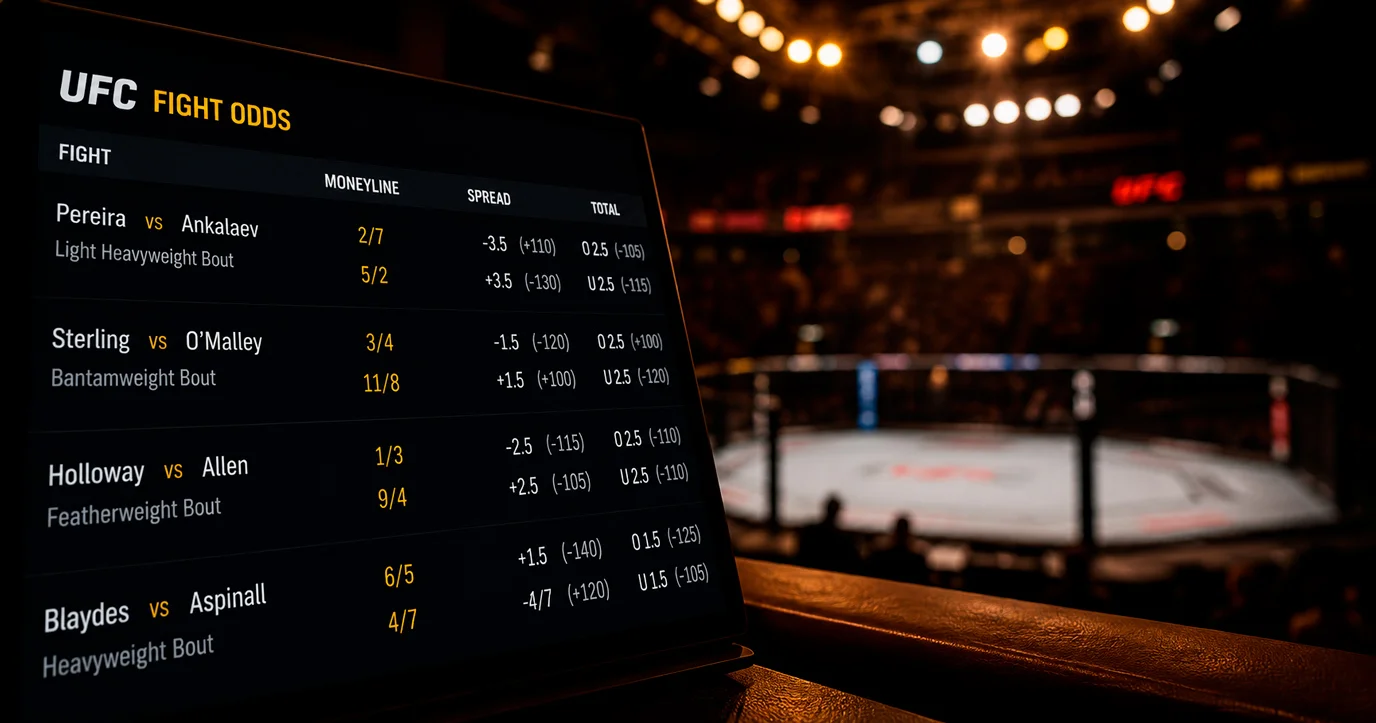
The relationship between the two numbers immediately tells you whether the fighter is a favourite or an underdog. When the first number is larger than the second — 7/2, 3/1, 11/4 — the fighter is the underdog. Their probability of winning is below 50%, so the bookmaker offers a larger profit relative to your stake to compensate for the higher risk. When the second number is larger — 4/9, 2/7, 1/3 — the fighter is the favourite. Their probability of winning is above 50%, so the profit is smaller relative to the stake.
Evens — written as 1/1 or simply “EVS” — means the profit equals the stake. A 10-pound bet at evens returns 20 pounds total. This is the exact midpoint: the bookmaker’s pricing implies a 50% probability of winning (before the margin is applied).
One common source of confusion is odds like 11/8 or 13/8, where neither number is a clean multiple of the other. The reading is identical: at 11/8, for every 8 pounds staked, the profit is 11 pounds. The numbers do not need to be round — the fraction simply expresses a ratio.
Calculating Payouts Step by Step
The formula for calculating your payout from fractional odds is straightforward: profit equals your stake multiplied by the first number, then divided by the second number. Add the original stake to get the total return.
Suppose you place 25 pounds on a fighter at 7/4. Profit equals 25 multiplied by 7, divided by 4. That gives you 175 divided by 4, which is 43.75 pounds. Total return is 43.75 plus your 25-pound stake, which equals 68.75 pounds.
Now take a favourite at 4/11. Profit equals 25 multiplied by 4, divided by 11. That is 100 divided by 11, which is 9.09 pounds. Total return: 34.09 pounds. The smaller payout reflects the higher probability the bookmaker assigns to this fighter winning.
Around 10% of UK adults bet on sports online, and the majority default to round-number stakes — 5 pounds, 10 pounds, 20 pounds. The calculation works identically regardless of the stake amount. A 10-pound bet at 5/2 returns 35 pounds total (25 profit plus 10 stake). A 100-pound bet at the same odds returns 350 pounds total (250 profit plus 100 stake). The ratio stays the same; only the absolute numbers change.
For very short-priced favourites, the profit relative to the stake can feel negligible. At 1/7, a 70-pound bet returns 80 pounds total — just 10 pounds profit for 70 pounds of risk. Understanding this relationship viscerally, not just mathematically, is what prevents beginners from overexposing themselves to heavy favourites where one loss wipes out several wins.
Converting Fractional to Decimal Odds
Decimal odds are the standard format in continental Europe, and many UK bookmakers offer the option to switch between formats. The conversion is simple: divide the first number by the second and add 1.
Fractional 7/2 becomes 7 divided by 2, which is 3.5, plus 1, which equals 4.50 in decimal. Fractional 4/9 becomes 4 divided by 9, which is 0.444, plus 1, which equals 1.44. Fractional 1/1 (evens) becomes 1 divided by 1, plus 1, equals 2.00.
Decimal odds express the total return per pound staked, including the stake itself. At decimal 4.50, every pound staked returns 4.50 pounds total. At decimal 1.44, every pound returns 1.44 pounds total. This format makes comparison between selections slightly easier because you are working with a single number rather than a ratio, but the underlying information is identical.
To convert back from decimal to fractional: subtract 1 from the decimal, then express the result as a fraction. Decimal 3.00 minus 1 equals 2, which is 2/1 in fractional. Decimal 1.50 minus 1 equals 0.50, which is 1/2 in fractional. Some conversions produce awkward fractions — decimal 2.60 minus 1 equals 1.60, which is 8/5 in fractional — but these are rare in practice because bookmakers set their odds to produce clean fractions.
For a broader exploration of how odds encode probability across all three formats — fractional, decimal, and American — and how to calculate implied probability from any of them, the odds explained guide covers the full framework.
Why UK Bookmakers Default to Fractions
Fractional odds are a product of British betting history. The format originated in horse racing — the oldest and most culturally embedded form of gambling in the UK — where odds were quoted as ratios at the track by bookmakers calling prices from their pitches. The tradition carried over into football, cricket, and every other sport that attracted British betting interest, including combat sports.
There is no mathematical advantage to fractional odds over decimal or American formats. The information is identical; only the presentation differs. But the cultural entrenchment is real. UK bookmakers default to fractions because that is what their core customer base grew up with, and switching the default would create friction for millions of existing users. Newer bettors — particularly those who started online rather than in betting shops — increasingly prefer decimal, which is why every major UK operator now offers format switching in their settings.
My recommendation: learn fractional first because it is the default you will encounter on every UK betting site, then use decimal as a conversion tool for comparison shopping and probability calculations. Once both formats are comfortable, you will read odds in either format without conscious effort — and the ability to switch between them is a small but genuine advantage when comparing prices across operators that display their odds differently.
The Format Is the Easy Part
Fractional odds are a language, not a strategy. Learning to read them fluently — to glance at 11/8 and immediately know that implies roughly 42% probability and pays 23.75 on a 10-pound stake — removes a barrier between you and the actual work of UFC betting: analysing matchups, identifying value, and managing your bankroll. Master the format, then forget about it and focus on what the numbers mean rather than how they are written.
How do I convert fractional UFC odds to decimal?
Divide the first number by the second and add 1. For example, 7/4 becomes 7 divided by 4 (1.75) plus 1, which equals 2.75 in decimal. The decimal figure represents your total return per pound staked, including the original stake. To convert back, subtract 1 from the decimal and express the result as a fraction.
Why do UK bookmakers use fractional odds instead of decimal?
Fractional odds are the traditional format in British betting, originating from horse racing where bookmakers quoted prices as ratios at the track. The format became standard across all UK sports betting and remains the default because of cultural familiarity. Most UK bookmakers now offer a setting to switch to decimal or American formats, so you can use whichever you find most intuitive.
Published by the how to bet on a ufc Fight team.