UFC Knockout Betting and Striking Finish Statistics
 Available in US
The loudest moment I have ever experienced at a live UFC event was a first-round knockout at a London card in 2023. The arena shook. The fighter who threw the punch looked almost surprised. And somewhere in the stands, a handful of bettors who had taken the KO/TKO method at 7/2 were collecting a payout that dwarfed the moneyline price of 2/5. Knockout betting is the intersection of raw violence and cold mathematics — and when the numbers line up, it offers some of the most generous prices in the sport.
Favourites won about 72% of all UFC bouts in 2024, but the method by which they won varied enormously depending on the division, the matchup, and the specific fighters involved. Understanding which fights are likely to end by stoppage — and which ones the market is mispricing — requires a different analytical toolkit than picking winners on the moneyline.
Divisional Finish Rates – KO Percentages by Weight Class
The UFC stages 43 live events annually — 13 numbered cards and 30 Fight Nights — and the knockout rate across those events is not distributed evenly. Division is the single strongest predictor of whether a fight ends by KO/TKO.
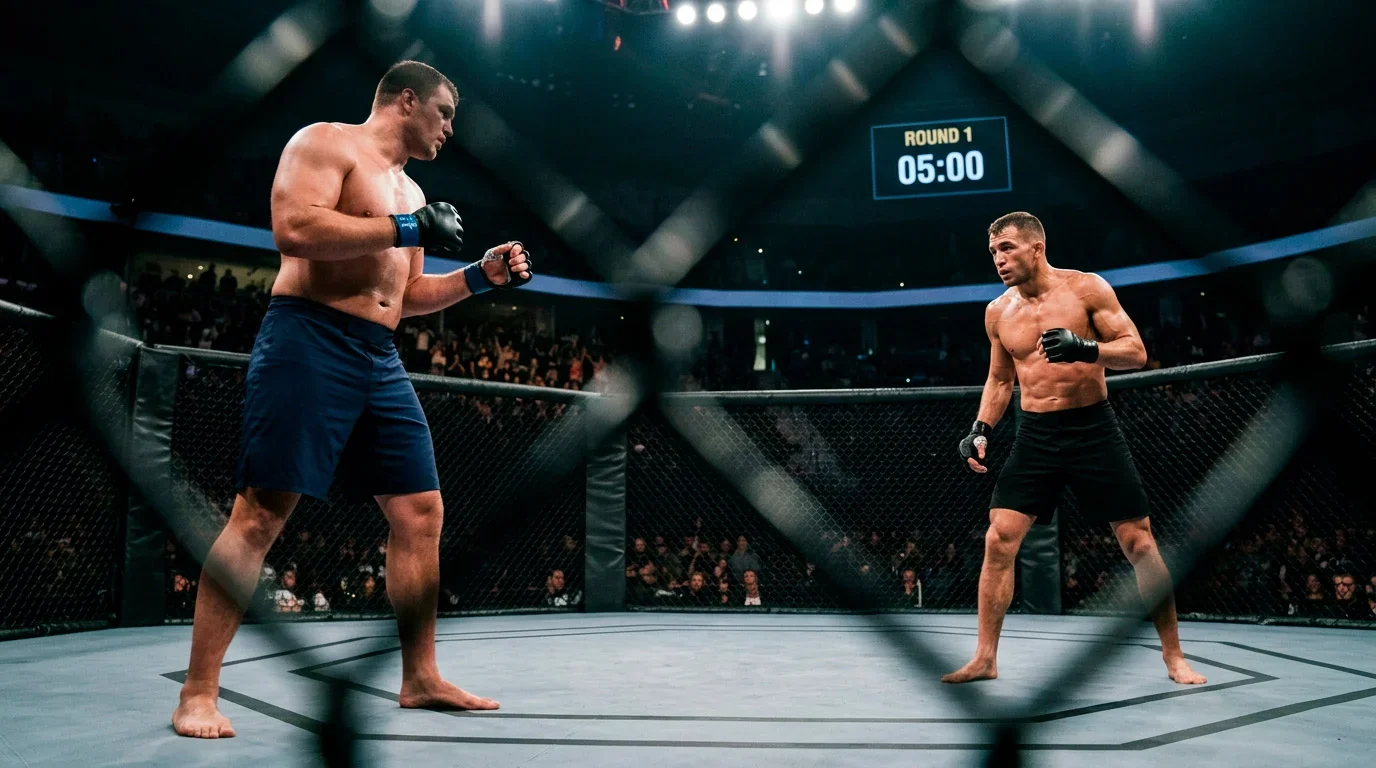
Heavyweight leads every other division by a wide margin. Approximately half of all heavyweight bouts end by knockout or technical knockout. The fighters weigh up to 265 pounds, they generate enormous force with every strike, and a single clean shot can end a contest regardless of the skill gap. Light heavyweight follows, with a KO/TKO rate well above the overall UFC average. At these weights, one-punch power is a genuine variable that no amount of technical skill can fully neutralise.
Middleweight and welterweight occupy the middle ground. Knockout rates are meaningful but not dominant — both divisions produce a mix of stoppages and decisions depending on the stylistic matchup. The KO/TKO method bet is viable here but requires more selectivity than at heavyweight, where the base rate does much of the work for you.
At lightweight and below, knockout rates decline steadily. The fighters are faster and more defensively sound, with less mass behind their strikes. Bantamweight and flyweight produce the fewest KO/TKO finishes relative to total fights, which makes knockout method bets in these divisions higher-risk propositions that demand very specific matchup conditions to justify.
The practical lesson: before placing any KO/TKO bet, check the division’s historical finish rate. If you are betting a knockout in a flyweight fight, you are swimming against the statistical current. If you are betting a knockout at heavyweight, the current is carrying you.
Power Metrics That Predict Stoppages
Not every fighter with a puncher’s reputation is actually likely to produce a knockout in a given fight. The metrics that genuinely predict stoppages are more specific than “knockout artist” or “power puncher” — labels the market overweights because they are dramatic and easy to remember.
Significant strikes landed per minute is the starting point. A fighter who averages 5.0 or more significant strikes per minute creates enough volume to generate finishing opportunities. But volume alone is not enough — a fighter who lands five strikes per minute but absorbs four is in a firefight, not controlling the distance. The differential between strikes landed and strikes absorbed is a stronger predictor of knockouts than raw output.
Knockout percentage — the proportion of a fighter’s career wins that came by KO/TKO — is useful but must be contextualised. A fighter with an 80% knockout rate built against regional-level opposition will not replicate that rate against UFC-calibre competition. Look at UFC-specific knockout rates rather than career totals, and weight recent fights more heavily than early-career data.
Toby from Punter2Pro makes a point that applies with particular force to knockout betting: underdogs win surprisingly often in MMA, and with the right analysis, bettors can find value where bookmakers may underrate a fighter’s style or momentum. In the knockout market, this manifests as underdog power punchers being priced too long because the market anchors on the favourite’s overall ability rather than the specific vulnerability the underdog exploits — chin exposure, poor defensive movement, a tendency to engage in close-range exchanges where one clean shot changes everything.
Defensive striking metrics matter as much as offensive ones. A fighter with a striking defence percentage below 50% is absorbing more than half of the significant strikes thrown at them. Against a power puncher, that absorption rate is an invitation for a stoppage. When one fighter has elite offensive output and the other has poor striking defence, the KO/TKO method probability spikes — and the price does not always reflect the spike fully.
Common KO/TKO Pricing Mistakes
The most frequent pricing error I see in knockout markets is overvaluing the moneyline favourite’s finishing ability while undervaluing the underdog’s. When a favourite is expected to win by KO, the market prices that outcome efficiently because it aligns with the public narrative. But the KO/TKO price for the underdog — the scenario where the less-fancied fighter lands the fight-ending shot — is often softer because fewer bettors consider it.
Heavyweight underdogs by KO/TKO is one of my most-bet markets for this reason. The division’s equalising power dynamic means that a heavyweight underdog at 3/1 on the moneyline might be 6/1 or 7/1 to win by knockout — a price that significantly overstates the difficulty of a heavy-handed fighter landing one clean shot in fifteen minutes of cage time.
Another mistake is conflating recent finishes with future finishing probability. A fighter who has knocked out three opponents in a row generates enormous public buzz, and the KO/TKO price shortens to reflect that streak. But knockout streaks are partially random — they depend on opponent quality, matchup dynamics, and timing as much as pure ability. The market prices the streak as if it is predictive, when often the fighter’s true knockout rate is lower than the recent run suggests. For a detailed framework on how striking metrics feed into broader fighter analysis, the fighter analysis guide covers the full toolkit.
Picking Your Spots in the Stoppage Market
Knockout betting rewards selectivity above all else. The fighters who produce stoppages consistently in the UFC share a specific profile: high offensive output, meaningful power differential over their opponent, and a matchup against someone with defensive vulnerabilities. When all three conditions align and the division’s base rate supports the thesis, the KO/TKO method market offers prices that the moneyline cannot match. Pick your spots, check the data, and let the public’s fascination with knockouts work in your favour by hunting for the scenarios they overlook.
What striking stats predict a UFC knockout?
The most predictive metrics are significant strikes landed per minute, the differential between strikes landed and absorbed, and the opponent’s striking defence percentage. A fighter who lands 5.0 or more significant strikes per minute against an opponent absorbing more than 50% of strikes thrown at them has an elevated knockout probability. Knockout percentage is useful context but should be weighted toward UFC-level fights rather than career totals.
Are heavyweight UFC fights more likely to end by KO?
Yes. Heavyweight has the highest knockout rate of any UFC division, with roughly half of all bouts ending by KO or TKO. The fighters carry enough mass and power that a single clean strike can end the contest regardless of skill differential. Light heavyweight also has an elevated KO rate, while lighter divisions like bantamweight and flyweight produce significantly fewer knockouts.
Prepared by the how to bet on a ufc Fight editorial staff.