UFC Round Betting and Over/Under Market Totals
 Available in US
The first time I cashed a round bet, it was almost by accident. I had backed a fighter to win in round two at 8/1, mostly because his opponent had a habit of fading after strong opening rounds. The finish came ninety seconds into the second, and the payout dwarfed anything I had collected on moneylines that month. That bet taught me something I keep coming back to: if you have a genuine read on fight duration, round markets and over/under totals are where the most generous prices live.
The UFC runs 43 live events every year — 13 marquee numbered cards and 30 Fight Night events — and each card features a mix of three-round and five-round bouts. That structural difference is the foundation of round betting, and understanding it is non-negotiable before you put money into these markets.
Exact Round Predictions – Trading Specific Finishes
Exact round betting is the most precise — and highest-paying — variation. You pick the specific round in which the fight ends and, in most markets, which fighter wins. A three-round fight gives you six possible selections per fighter (win in round one, win in round two, win in round three), while a five-round fight extends to ten. Some bookmakers simplify this into round groups (rounds one to two, rounds three to four) rather than individual rounds, which lowers the odds but raises the hit rate.
What makes this market interesting is how poorly the public prices fight duration. Casual bettors tend to overvalue first-round finishes because they are dramatic and memorable. The result is that later rounds — particularly round two and round three finishes — are often slightly underpriced relative to their actual frequency. Fighters who start slowly, build reads on their opponent’s timing, and then pour on pressure in the second round are classic candidates for a round-two selection.
I treat exact round bets as high-conviction plays. If I do not have a clear reason to believe the fight ends in a particular round, I leave this market alone. There is no shame in passing. The prices are long because the probability is genuinely low, and sprinkling bets across multiple rounds hoping to get lucky is a fast way to drain a bankroll.
Over/Under Rounds
Favourites won about 72% of UFC bouts in 2024, but that number does not tell you anything about how long those fights lasted. Some favourites finish fast. Others grind out decisions. The over/under market is where you express an opinion on duration without needing to pick a winner at all.
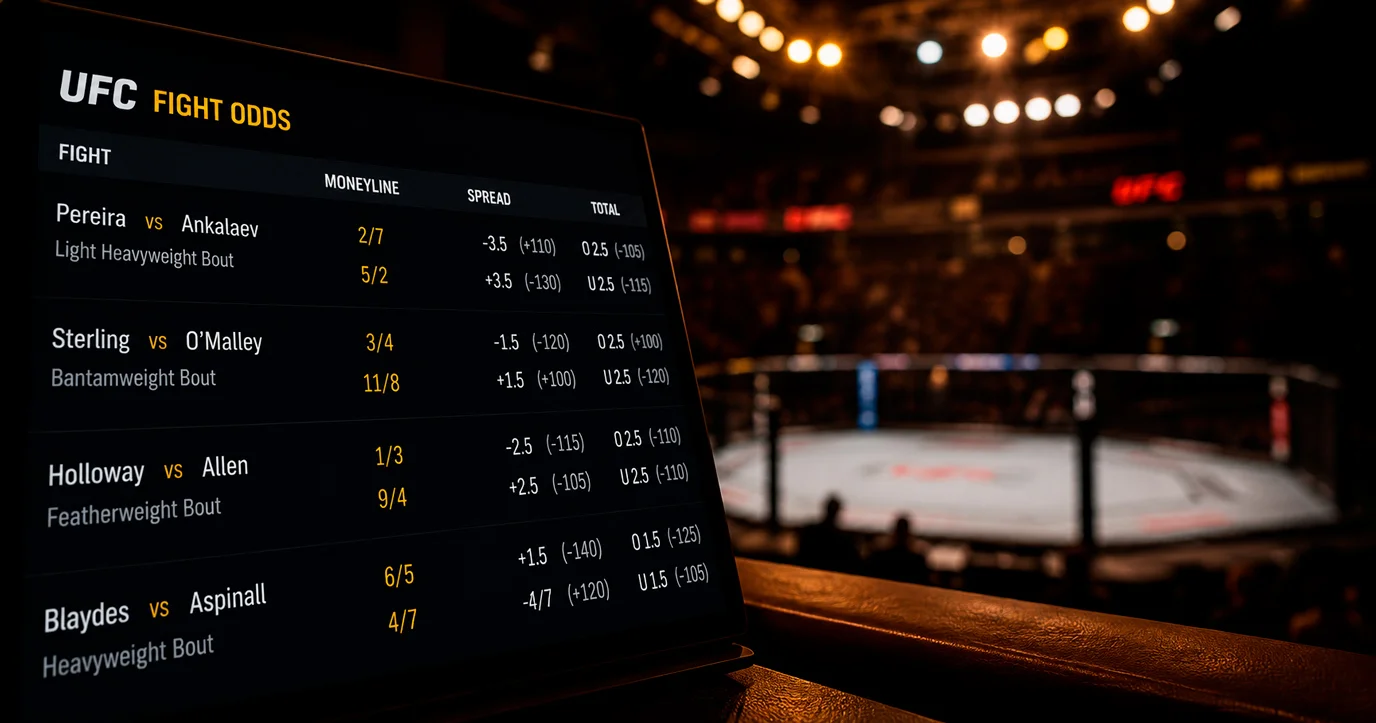
The standard line for a three-round fight is set at 1.5 or 2.5 rounds. For a five-round fight, it is typically 2.5 or 3.5 rounds. Bookmakers adjust the line and the odds based on the matchup. A bout between two explosive knockout artists might see over/under 1.5 rounds with the under favoured. A clash between two durable wrestlers could push the line to 2.5 with the over at short odds.
Understanding the half-round convention trips up newcomers. Over 2.5 rounds means the fight must enter the third round — specifically, it must continue past the halfway point of the third round (two minutes and thirty seconds into a five-minute round). If the fight ends at 2:29 of round three, the under wins. At 2:31, the over wins. This midpoint rule exists to prevent dead-heat scenarios and is standard across UK bookmakers.
The over/under is my go-to market when I believe a fight has a clear duration profile but I am less sure about the winner. Two grapplers who are likely to neutralise each other on the ground? Over. A devastating power puncher against a fighter coming off a long layoff? Under. The beauty of this market is that it sidesteps the who-wins question entirely and lets you bet on a dimension of the fight you may understand better than the average punter. Toby from Punter2Pro puts it well: underdogs win surprisingly often in MMA, and with the right analysis, bettors can spot value where bookmakers underrate a fighter’s style or momentum. That same logic applies to totals — the way a fight unfolds often matters more than who gets their hand raised.
Three-Round vs Five-Round Fights and What Changes
This distinction is not a footnote — it fundamentally reshapes the betting landscape. Three-round fights are the standard for non-main-event and non-title bouts. Five-round fights are reserved for main events (the last fight on the card, regardless of whether a belt is on the line) and championship bouts. The extra two rounds change everything.
Five-round fights go to the scorecards more often than three-round fights because both fighters have additional time to recover from difficult moments. A knockdown in round one that might lead to a finish in a three-rounder can be absorbed and survived in a five-rounder, shifting the fight toward a decision. Cardio becomes a bigger factor. Fighters who coast through the first three rounds and pour it on in the championship rounds — a pattern common among experienced title contenders — create a different kind of over/under dynamic.
For betting purposes, five-round fights push the probability toward the over and toward the decision market. If you are considering under 2.5 in a five-round fight, you need very strong evidence that a finish is coming early, because both fighters have more time and incentive to pace themselves. Conversely, in a three-round bout between two aggressive finishers, the under can be an excellent play because neither fighter has the luxury of time to be cautious.
I always check whether a fight is scheduled for three or five rounds before looking at any totals line. The same two fighters could warrant opposite over/under bets depending on the format.
Reading Half-Round Lines Without Getting Caught Out
Half-round lines are simple in theory but create confusion in practice, so let me spell it out with an example. Suppose the line is set at over/under 1.5 rounds for a three-round fight. Fighter A wins by TKO at 3:15 of round two. The fight ended in round two, which is past the 1.5 mark, so the over wins. Now suppose Fighter A wins at 1:45 of round two. Still round two, still past 1.5 — the over still wins. The under only wins if the fight ends in round one.
Where it gets trickier is the 2.5 line. With that line, the fight needs to reach the midpoint of round three for the over to cash. A finish at any point in rounds one or two is an under. A finish in the first half of round three — before 2:30 on the clock — is also an under. Only once the fight passes that midpoint does the over kick in.
Some bookmakers also offer 0.5 lines on five-round fights, which simply means the fight must finish in the first round for the under to land. At the other extreme, 4.5 on a five-rounder means the fight must enter the second half of the final round for the over — essentially, the fight needs to go almost the full distance.
My advice is to ignore any line where you do not have a clear opinion. If you are staring at over/under 2.5 and your honest assessment is “could go either way,” then the market has priced it correctly and there is no edge for you to exploit. Save your stake for a fight where the duration feels genuinely mispriced. For more on how fight distance connects to decision outcomes, have a look at the decision betting strategy guide.
Duration Tells You More Than You Think
Round betting and over/under markets reward a different kind of analysis than the moneyline. They ask you to think about how a fight unfolds over time — the pacing, the cardio, the tactical adjustments between rounds. That focus on process rather than outcome is why I find these markets so appealing. You can be right about the fight’s shape without needing to pick the winner, and when your read on duration is sharp, the prices available are consistently more generous than anything the moneyline offers.
What does over 2.5 rounds mean in a UFC fight?
Over 2.5 rounds means the fight must continue past the midpoint of the third round — specifically, past two minutes and thirty seconds into round three. If the fight ends before that point, the under wins. This applies to both three-round and five-round fights, though the line is more commonly offered in three-round bouts.
How do three-round and five-round fights affect the over/under line?
Five-round fights generally push the probability toward the over because both fighters have more time to recover from difficult moments and are more likely to pace themselves. Three-round fights, with less time available, tend to produce finishes at a higher rate relative to the total rounds scheduled. Bookmakers adjust the line accordingly, so always check the scheduled distance before evaluating a totals bet.
Published by the how to bet on a ufc Fight team.